Data4Lyf · DubsTech Datathon 2026 · Technology Track

Where Technology Fails

A real-world accessibility analysis showing where digital systems exclude users, which failures repeat, and which fixes prevent the most harm.

3,524
Violations
~590
Unique pages
6
Domains
~80%
Preventable (best-case)
01 — The Challenge

Technology isn’t neutral

Many websites unintentionally block people with disabilities. These barriers can be invisible to builders, but very real for users who rely on screen readers, keyboard navigation, or who have low vision.

What we studied

Using the AccessGuru dataset aligned with WCAG 2.1, we examined where accessibility failures occur, which violations dominate, and which pages create the greatest user harm.

How we worked

We standardized domain labels, filtered unsuccessful scrapes, aggregated by page and domain, and used severity-weighted scoring to prioritize remediation where it matters most.

02 — Key Findings

What we discovered

Accessibility failures are not random. They cluster by domain, repeat across sites, and concentrate harm on a smaller set of pages.
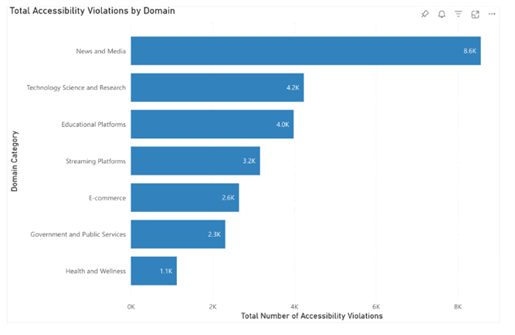
Violations by domain
Figure 1: News & Media shows the highest violation volume, suggesting risk rises with content scale and publishing velocity.
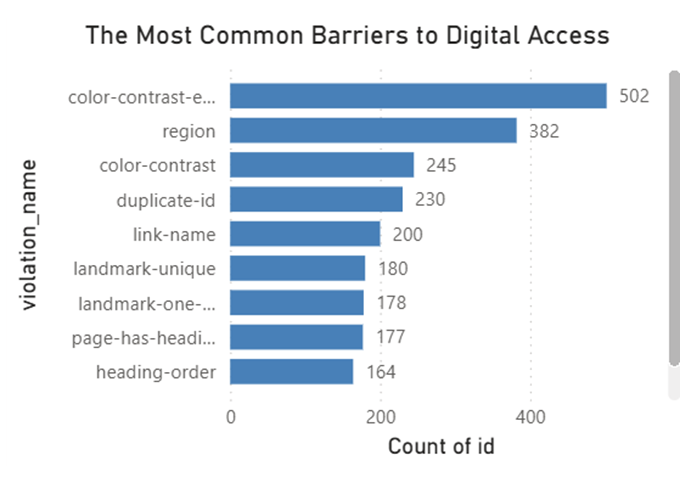
Top violations
Figure 2: A small set of violations (contrast, landmarks, link names, duplicate IDs, headings) dominate—pointing to design-system and workflow gaps.
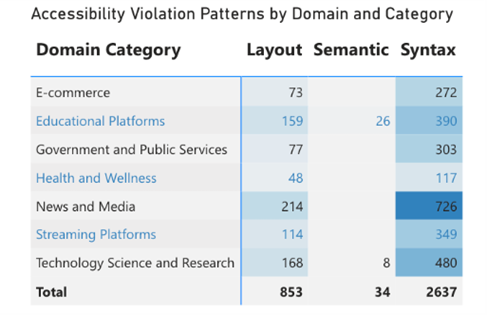
Heatmap Domain x Violation Category
Figure 3: Syntactic violations dominate overall; semantic violations are fewer but disproportionately impact screen reader users.
03 — Severity & Harm

Risk Score: impact beats volume

Not all violations are equal. Some pages have fewer issues but more critical ones. We created a Risk Score to prioritize user harm.

Risk Score formula

5× Critical · 4× Serious · 3× Moderate · 2× Minor

Unlike raw counts, Risk Score helps focus remediation on the pages that block users most.

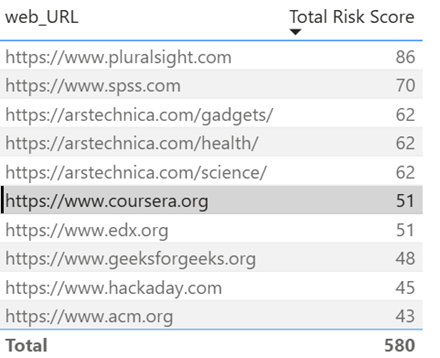
Risk score ranking
Figure 4: Severity-weighted ranking surfaces the pages causing the greatest harm—useful for triage and planning.
04 — Hidden Patterns

Clustering reveals problem families

We clustered pages by violation patterns (KMeans, k=5; silhouette 0.334). Four clusters form meaningful “problem families”; one is low-violation outliers.

Problem family 1

Contrast-heavy pages — dominated by color contrast violations (harmful for low-vision users).

Problem family 2

Navigation confusion — missing landmarks/regions, making screen reader navigation unreliable.

Problem family 3

Structure-broken — duplicate IDs and broken HTML cause assistive tech to misinterpret page structure.

Problem family 4

Heading disorder — incorrect heading hierarchy prevents users from skimming content.

05 — Human Impact

Who gets excluded?

These failures aren’t just technical—they block real people from using digital services.

Examples of harm

ViolationWho it harmsWhy it matters
Color contrastLow-vision usersText becomes unreadable
Missing link namesScreen reader usersLinks lack meaning and context
Missing landmarksBlind usersNavigation breaks; users get lost
Duplicate IDsAssistive tech usersPage structure becomes ambiguous or unusable
06 — High-Impact Fixes

Four fixes prevent most violations

Based on violation types in the dataset, consistent implementation of these practices can prevent a large share of observed issues (best-case).

21.2%
Color contrast
24.7%
Semantic landmarks
12.0%
Link + alt text
21.7%
Structure + headings

Fix color contrast

Enforce WCAG contrast thresholds with automated checks in design tools and CI pipelines to prevent regressions before deployment.

Add semantic landmarks

Standardize <nav>, <main>, <header>, <footer> across templates to make screen reader navigation reliable.

Meaningful link text + alt text

Replace vague links (“click here”) with descriptive labels, and ensure image-links include appropriate alt text for context.

Validate HTML structure

Enforce unique IDs and a logical heading hierarchy using linting/testing to improve assistive-technology interpretation.

Best-case impact

Addressing these four design practices could prevent nearly 80% of observed violations (2,802 of 3,524), assuming consistent implementation across templates and components.